One Earth says it needs one CO2 injection well. Why is it still asking for three?
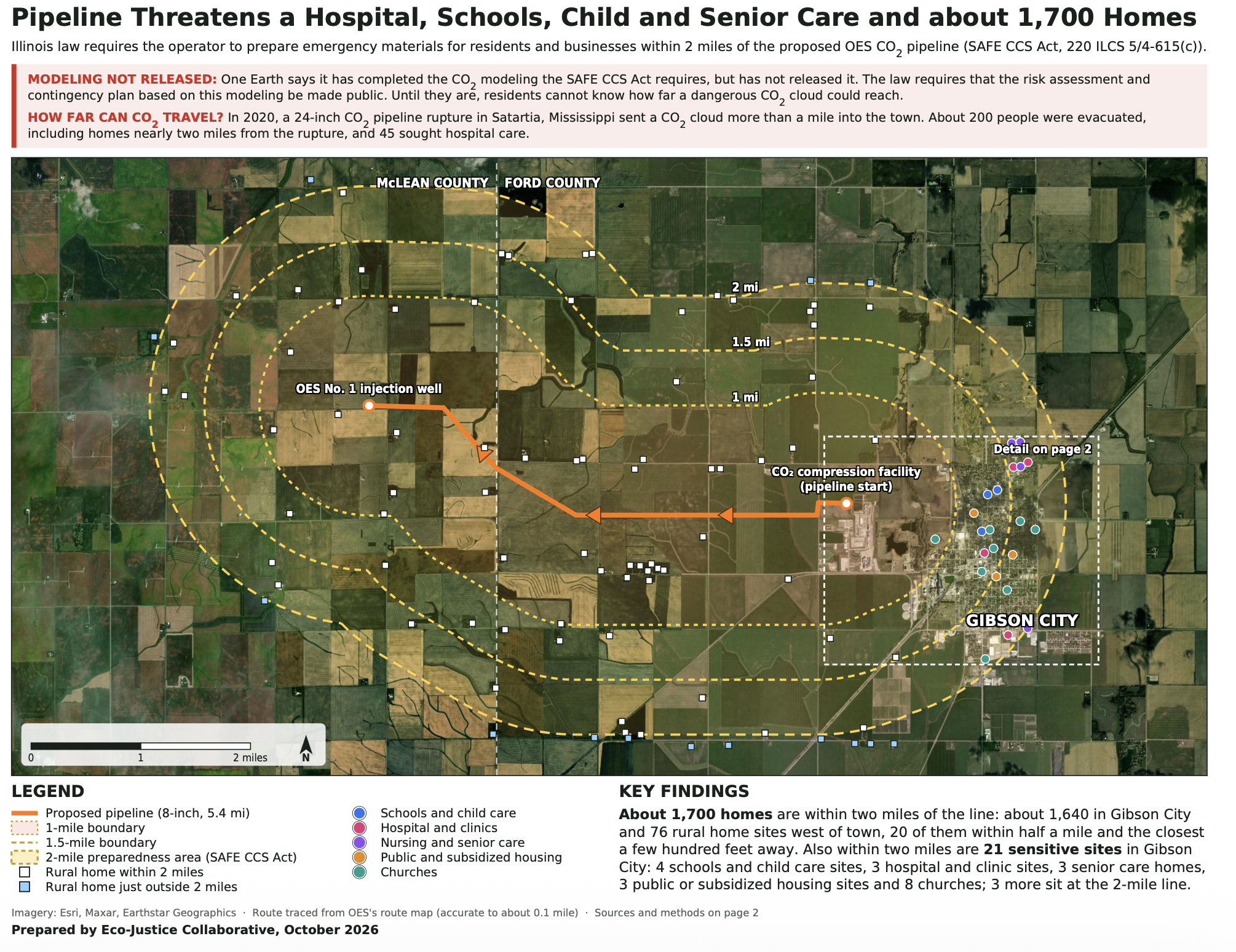
At its October 7 and October 15 pre-filing meetings, One Earth representatives presented a project that sounded smaller and safer: an 8-inch pipeline, about 5.4 miles long, carrying CO2 from its Gibson City ethanol plant to a single injection well in McLean County. One well instead of three. About 585,000 tons of CO2 a year instead of 1.5 million.
That sounds like a real concession, and we understand why it might reassure people in Ford and McLean Counties. But if you look at what One Earth is still asking the U.S. EPA to approve, the picture changes.
A well needs CO2 to fill it
Every carbon storage project has three parts: a source of CO2, a pipeline to move it, and a well to bury it. Each depends on the others. A well with no CO2 flowing to it is worthless.
One Earth Sequestration (OES) says it needs one well. Yet it is still seeking EPA Class VI permits for three wells, with room to store 90 million metric tons of CO2 over 20 years. One Earth Energy's president said OES plans to inject only about 11.7 million tons, about 13 percent of that.
That leaves 88.3 million tons unaccounted for
No prudent company invests heavily in permits for nearly eight times the storage its own plant will use. If all three permits are granted, the next step is obvious: find more CO2 to fill them. That means more sources and more pipelines.
Where could the rest come from?
We don't have to guess where One Earth might look. In 2023, the Illinois Commerce Commission asked about OES's storage capacity, and One Earth answered with a list of 30 possible CO2 sources for its hub. They include:
- Ethanol and agricultural processing plants in Gibson City, Gilman, and Kankakee
- Power plants in Champaign, Monticello, Normal, and Tilton
- Natural gas pipeline and storage facilities from Cropsey to Tuscola
- Landfills in Bloomington, Pontiac, Clinton, Hoopeston, and Danville
Getting CO2 from any of those sites to Gibson City would take new pipelines across east-central Illinois.
Then there is One Earth's parent company, REX American Resources. REX owns 76.1 percent of One Earth Energy and 99.7 percent of NuGen Energy in Marion, South Dakota, and holds a 10.3 percent stake in Big River Resources, which runs four more ethanol plants in Iowa, Illinois, and Wisconsin. Together, those six plants produce about 722 million gallons of ethanol a year, and with it roughly 2 million metric tons of CO2, more than three times what OES says it will capture in Gibson City. REX is already pursuing carbon sequestration at One Earth. Could CO2 from its other plants be piped in to fill the extra space?
See the maps
Our maps start with the 5.4-mile pipeline OES is taking to the ICC and the three wells it wants EPA to permit. Then they show every source One Earth named that had a usable address, along with REX's other ethanol plants, so you can see what a fully used OES hub could look like.
The routes from those other sources are illustrative straight lines, not actual proposed routes. That is the point: One Earth hasn't told the public what it plans to do with the other 88.3 million tons.
Questions One Earth should answer
- Will OES withdraw its permit applications for wells 2 and 3 and then submit a new application to the U.S. EPA?
- If not, what will those wells be used for?
- Will One Earth, REX, or a partner come back to the ICC for more pipelines, and larger ones, through other parts of McLean and Ford Counties?
- Will One Earth tell its neighbors the full scope of its plans now, before this goes any further?
People who live above the Mahomet Aquifer and along these potential routes deserve the whole picture, not just the smallest piece of it.
Our ask of you:
- Go to One Earth's webpage: https://bit.ly/4zzeI5i
- Scroll down to item #8, Questions and Comments.
- Use the comment form at the end of that section to ask One Earth how the additional 88.3 MMT CO2 they are asking the U.S. EPA permit will reach those wells, and whose farms it will cross.